


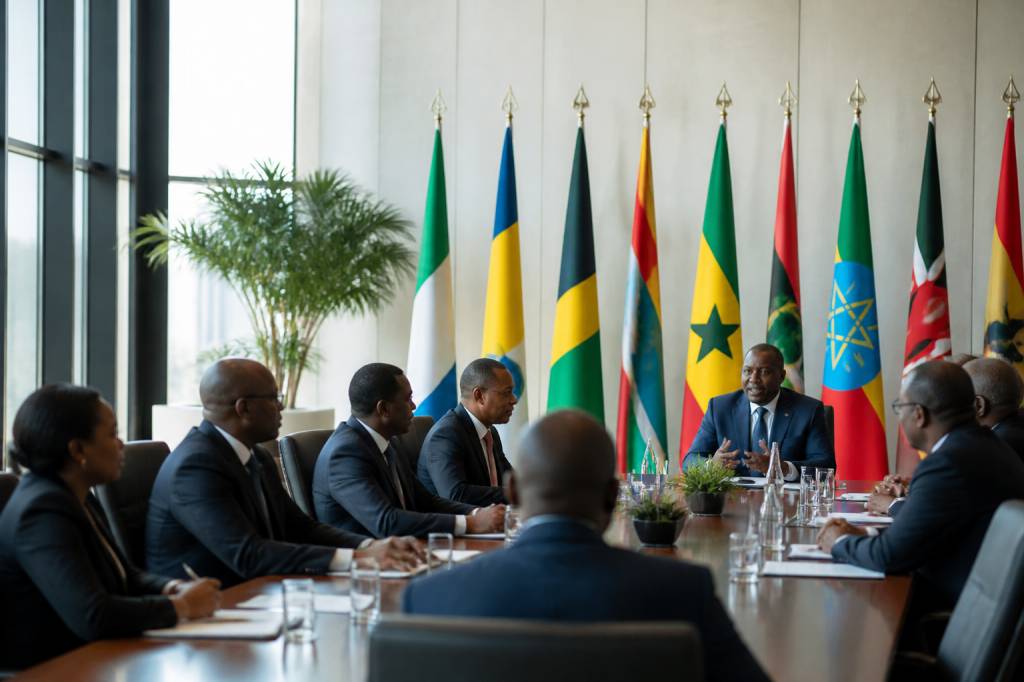
In 2026, African politics will not be a side story for business leaders. It will be part of the operating environment. For companies active on the continent, or sourcing from it, or exporting into it, political developments will shape costs, delivery times, regulatory risk, financing conditions, and even where factories get built. The old habit of treating Africa as a single market with a few headline risks is no longer useful. Political dynamics are increasingly local, fast-moving, and directly tied to industrial performance.
That matters because Africa is entering 2026 with strong long-term fundamentals: a young population, rapid urbanization, rising demand for infrastructure, and a growing role in global supply chains for energy transition materials, agribusiness, logistics, and consumer goods. But none of that automatically translates into predictable business conditions. In many countries, the key question is not whether the market exists. It is whether the rules will stay stable long enough for capital to be deployed and recovered.
Politics is now a supply chain issue
In boardrooms, political risk used to sit in the “government relations” folder. In 2026, it sits closer to procurement, logistics, and production planning. A disputed election, a sudden import restriction, a change in customs enforcement, or a currency control measure can disrupt a supply chain faster than a port strike. And in many African markets, politics affects the physical movement of goods as much as the legal environment.
Take transport corridors. A mining company in Zambia, a food processor in Kenya, or a manufacturer in Côte d’Ivoire depends not only on local policy, but also on cross-border cooperation, road security, customs harmonization, and the reliability of neighboring states. If a border post slows down, if fuel subsidies are adjusted abruptly, or if a government changes tax treatment on strategic imports, the impact is immediate. Trucks wait. Warehouses fill. Cash flow tightens. The spreadsheets do not care that the problem is “political.”
For industrial operators, this means one thing: political monitoring must be integrated into operational planning. Not as a vague country risk memo, but as a monthly input into sourcing, inventory, and capex decisions. That is increasingly standard practice among multinationals. More local firms are adopting the same discipline, often after learning the hard way.
Election cycles will keep reshaping the business climate
In 2026, elections and post-election transitions will remain among the biggest sources of uncertainty across the continent. The issue is not only whether elections are peaceful. It is whether they produce policy continuity, credible institutions, and a predictable business climate afterward. Markets dislike ambiguity almost as much as they dislike instability.
In some countries, election seasons may trigger temporary spending freezes, delays in public procurement, and caution from lenders. In others, they may lead to policy reversals, especially in sectors seen as politically sensitive: fuel, food, telecoms, mining royalties, land, and strategic infrastructure. A new administration can bring reform momentum, but it can also reopen contracts, revisit tax incentives, or change the pace of privatization.
For businesses, the practical takeaway is simple: do not assume that a pre-election investment case will survive unchanged after the vote. Stress-test your assumptions. What happens if customs duties shift? If a subsidy is cut? If local content rules are tightened? If a new government wants to renegotiate a power purchase agreement? These are not theoretical questions. They are the kind that decide whether a plant runs at 70% or 90% capacity.
Industrial policy is becoming more assertive
Across Africa, political leaders are under pressure to show tangible economic results. That has encouraged a stronger focus on industrial policy, local value addition, and import substitution. In 2026, expect more governments to use policy tools to encourage domestic processing, protect strategic sectors, and capture more value from natural resources.
For industry, that can be both an opportunity and a challenge. On the positive side, governments are more open to partnerships that create jobs, transfer skills, and develop local supplier ecosystems. This is particularly visible in agribusiness, pharmaceuticals, packaging, construction materials, renewable energy assembly, and mineral beneficiation. Companies that can localize part of the value chain often gain access to incentives, public support, and stronger political legitimacy.
On the other hand, assertive industrial policy can also mean more bureaucracy, tougher local content requirements, and less flexibility in sourcing. A manufacturer importing equipment or intermediate goods may face higher compliance costs. A logistics provider may have to navigate new licensing rules. An investor entering a strategic sector may need to spend as much time on stakeholder alignment as on financial modeling.
The key is to read policy signals early. When a government starts talking about food security, import substitution, or industrial sovereignty, businesses should hear more than a speech. They should hear a future regulatory agenda.
Currency politics and capital controls will stay central
For many African businesses, the most immediate political risk is not elections. It is foreign exchange. In 2026, currency volatility will continue to shape trade, debt servicing, and import planning. In several economies, policy responses to inflation, external shocks, or pressure on reserves may include tighter currency management, restrictions on profit repatriation, or administrative controls on access to foreign exchange.
That creates a very practical problem for industry. A factory can be operationally efficient and still struggle if it cannot source spare parts, energy inputs, or packaging materials on time. A distributor can have strong sales and still lose money if it cannot convert local currency into dollars or euros when needed. The political dimension is obvious: central bank decisions, fiscal deficits, and reserve management are never purely technical in these markets.
Businesses should therefore pay close attention to reserve levels, balance-of-payments trends, IMF negotiations, and government responses to inflation. Not because they want to become macroeconomists overnight, but because liquidity rules the real economy. A stable exchange rate policy can be worth more than a subsidy.
Security and governance remain operational variables
Some of the most consequential political developments in Africa in 2026 will be linked to security. In parts of the Sahel, the Horn of Africa, the Great Lakes region, and other fragile zones, insecurity can affect transport routes, insurance costs, staff mobility, and the viability of industrial investment. This is not only a humanitarian issue. It is a business continuity issue.
Companies operating in or near higher-risk zones need to think beyond physical security guards and perimeter fencing. They need route mapping, contingency warehousing, flexible delivery schedules, and strong local intelligence. A delayed convoy, a blocked road, or a sudden movement restriction can be as damaging as a tariff increase.
Governance quality also matters. Weak public administration creates hidden costs: slow permits, inconsistent enforcement, repeated inspections, and opaque tax claims. Even in countries with strong market potential, poor governance can flatten margins. Ask any logistics manager who has spent a week resolving one missing signature. They will tell you the same thing: in business, friction is expensive.
Where the opportunities are likely to grow
Political change is not only a source of risk. It can also create openings for businesses that move early and adapt well. In 2026, several sectors are likely to benefit from policy priorities across African markets.
-
Agribusiness and food processing: Governments remain focused on food security, import reduction, and rural employment. That supports investment in storage, processing, irrigation, cold chain, and mechanization.
-
Logistics and warehousing: Trade facilitation, regional integration, and e-commerce growth are increasing demand for modern logistics assets. Political support for corridor development can unlock new routes and distribution hubs.
-
Energy and utilities: Industrial growth depends on reliable power. Public-private partnerships, grid expansion, and off-grid solutions are likely to stay high on the agenda.
-
Mining and mineral processing: Critical minerals remain strategically important. Governments want more local value addition, which creates opportunities for processing, engineering, and industrial services.
-
Construction and industrial inputs: Urban growth and infrastructure spending continue to support demand for cement, steel, glass, cables, and related materials.
In each of these sectors, political alignment matters. The best projects are not always the most technically elegant. They are often the ones that fit national priorities, create visible jobs, and can survive a change of minister.
What investors should watch in 2026
For companies operating in Africa, the smartest strategy is not to predict politics perfectly. That is impossible. The smarter move is to build resilience around likely scenarios. In practical terms, that means watching a few core indicators closely.
-
Election calendars and transition risks: Look not just at voting dates, but at the likelihood of delayed results, coalition bargaining, and post-election policy shifts.
-
Fiscal pressure: Rising deficits often lead to new taxes, delayed payments to suppliers, or cuts in capital expenditure.
-
Regulatory changes: New local content rules, sector levies, customs reforms, and licensing requirements can alter business models quickly.
-
Cross-border relations: Regional tensions, border closures, and trade disputes can disrupt sourcing and distribution.
-
Public sentiment: Inflation, unemployment, and fuel costs can trigger political responses that directly affect firms.
It is also wise to maintain local partnerships. In many African markets, the difference between a policy headache and a manageable issue is often the quality of local relationships. That does not mean buying influence. It means understanding how decisions are made, who actually matters in the chain of command, and how to communicate in a way that respects both formal rules and local realities.
Practical responses for business leaders
If 2026 brings more political complexity, companies do not need to panic. They need to be better prepared. The strongest operators will treat political analysis as a core business function, not an externality.
That starts with scenario planning. A company importing raw materials should model what happens if customs delays increase by three days. A manufacturer should test cash flow under exchange-rate pressure. A distributor should know which routes can be rerouted if a border becomes congested. A lender should understand which sectors are most exposed to political intervention.
It also means diversifying where possible. Not every business can move production, but most can reduce concentration risk. That could mean multiple suppliers, alternative ports, more flexible inventory policies, or regional rather than single-country exposure. In Africa, resilience is often a competitive advantage, not just a defensive posture.
Finally, companies should invest in data. Political risk is easier to manage when it is tracked systematically. That includes local news monitoring, policy tracking, customs data, sector interviews, and regular feedback from field teams. The people on the ground often spot the shift before the official communiqué does.
Why this matters for the industrial cycle
By 2026, African politics will be less about ideology and more about execution. Can governments deliver stable power, efficient customs, functioning transport corridors, and credible regulation? Can they balance revenue needs with investor confidence? Can they turn industrial promises into actual output?
For business and industry, those questions are not academic. They shape margins, plant utilization, inventory levels, and expansion plans. The companies that will perform best are those that understand a basic truth: in Africa, politics is not outside the economy. It is embedded in it.
That is not a reason to stay away. Quite the opposite. It is a reason to get informed, build flexible operations, and choose markets and partners with care. In a year where political developments will remain closely tied to economic performance, the winners will be the firms that can read the terrain before everyone else notices the road has changed.