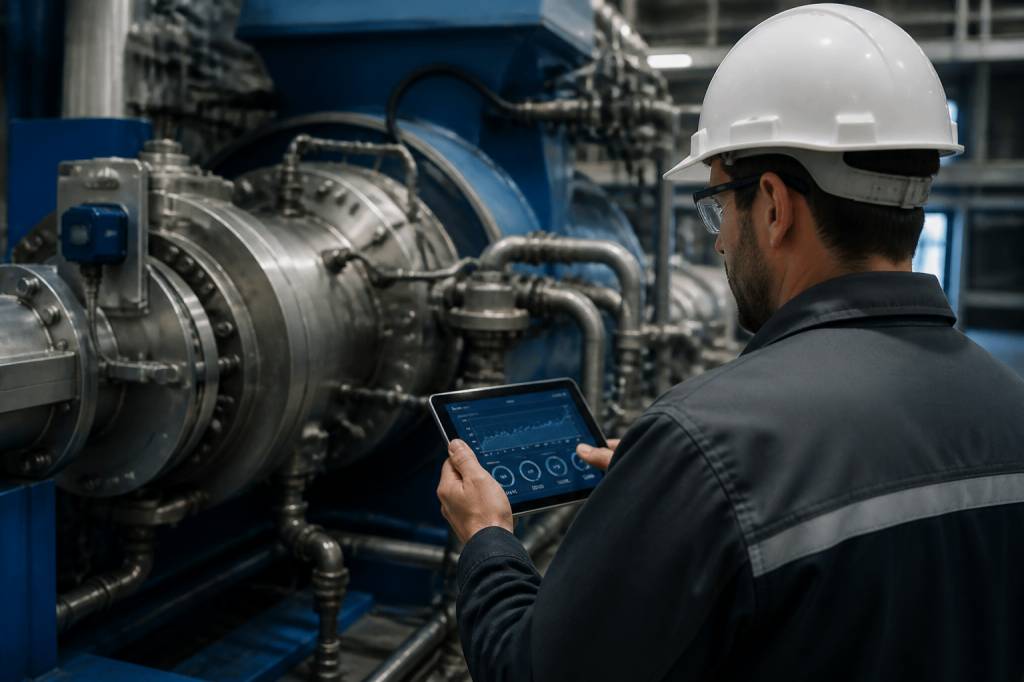
Industrial asset management is moving from a back-office maintenance function to a strategic discipline. Plants, warehouses, fleets and production lines are under pressure to deliver more output with fewer resources, while energy costs, labour shortages and supply chain disruptions continue to test operating models.
The result is a clear shift in priorities. Companies are no longer asking only whether a machine is working. They want to know how much value it is generating, how much risk it carries, when it should be upgraded and whether its environmental footprint remains acceptable.
Recent developments in industrial asset management show that the sector is entering a more connected, data-driven and service-oriented phase. Technology remains important, but the real transformation lies in how companies use information to make operational decisions.
From maintenance schedules to asset performance
For decades, industrial maintenance was largely organised around fixed schedules. Equipment was inspected every month, every quarter or after a predetermined number of operating hours. This approach remains useful for some assets, but it has one major weakness: it does not always reflect the real condition of the equipment.
A production line operating in a dusty environment, for example, may deteriorate faster than an identical line installed in a controlled facility. Conversely, a lightly used machine may receive unnecessary interventions simply because the calendar says it is time for inspection.
Asset performance management is changing this model. Maintenance teams are increasingly combining historical records, sensor data, operating conditions and production requirements to determine the most appropriate intervention.
The objective is not simply to reduce maintenance costs. It is to improve the relationship between reliability, output, safety and capital expenditure. A cheaper maintenance programme that creates more unplanned downtime is not a saving. It is merely a delayed invoice.
Predictive maintenance becomes more practical
Predictive maintenance has been discussed for years, but industrial companies are now moving from pilot projects to wider deployment. The main reason is the increasing availability of connected sensors and more accessible analytical tools.
Vibration, temperature, pressure, energy consumption and acoustic data can reveal early signs of failure. When this information is analysed over time, maintenance teams can identify abnormal patterns before a component reaches a critical condition.
A bearing that shows a gradual increase in vibration may not need immediate replacement. However, the trend could indicate that a failure is developing. The maintenance department can then plan the intervention during a scheduled production stop instead of responding to an emergency breakdown.
This approach is particularly valuable in sectors where downtime is expensive, including automotive manufacturing, food processing, chemicals, pharmaceuticals and logistics. In these environments, a short stoppage can affect production targets, delivery commitments and customer relationships.
Still, predictive maintenance is not a magic software package. It depends on reliable data, appropriate sensors and technicians who understand the operational context. An algorithm can detect an unusual signal, but an experienced engineer is often needed to explain what it means.
Artificial intelligence moves closer to the factory floor
Artificial intelligence is becoming one of the most visible themes in asset management news. Industrial companies are using machine learning models to detect anomalies, forecast equipment failures and prioritise maintenance work orders.
The most useful applications are usually the least spectacular. Instead of replacing the maintenance department, AI helps teams process large volumes of information faster. A system can review thousands of sensor readings and highlight the five assets that require attention first.
AI can also support technicians by bringing together manuals, maintenance histories, inspection reports and previous incidents. When a problem occurs, the operator can access relevant information without searching through several databases or paper documents.
Generative AI is beginning to add another layer. In controlled environments, it can help draft maintenance summaries, convert technical notes into structured reports or provide step-by-step guidance for standard procedures. These applications remain subject to strict validation, particularly in sectors where safety and regulatory compliance are essential.
The central question is not whether a company has an AI strategy. It is whether the organisation has a clearly defined operational problem that AI can solve. Technology without a measurable use case quickly becomes another abandoned pilot project.
Digital twins connect physical assets with business decisions
Digital twins are also gaining ground in industrial operations. A digital twin is a digital representation of a physical asset, process or facility that is updated with operational data.
At a basic level, it can be used to monitor the condition of a machine. More advanced models simulate how an asset or production system would respond to different operating conditions. This can help companies test changes before applying them in the real world.
For example, a manufacturer could assess the impact of increasing production speed, changing a raw material or modifying a maintenance interval. A logistics operator could simulate the effect of adding automated storage equipment to an existing warehouse.
The value of a digital twin increases when it is connected to financial and operational data. A technical failure is not just a technical event. It may affect production volumes, labour costs, energy consumption, inventory levels and customer service.
This broader perspective is essential for industrial asset management. The best decision is not always to repair an asset. In some cases, replacement, redesign or process modification may deliver better long-term results.
Connected workers remain essential
Industrial digitalisation does not eliminate the need for skilled workers. In many sectors, it makes their expertise more valuable.
Maintenance departments are facing a demographic challenge as experienced technicians retire and fewer young workers enter certain industrial professions. Companies are therefore investing in mobile tools, digital work instructions and remote assistance to support both experienced and less experienced employees.
A technician equipped with a tablet or smart glasses can access equipment history, technical drawings and safety procedures directly at the worksite. Remote experts can also guide interventions without travelling to every plant or warehouse.
This has practical benefits. It reduces the time spent looking for information, improves the consistency of inspections and makes it easier to document completed work. It can also help preserve knowledge that would otherwise leave the company when an experienced employee retires.
However, technology should not create additional complexity. A worker should not have to complete ten digital forms to report a problem that previously required a simple note. The most effective tools are designed around the workflow, not around the software demonstration.
Cybersecurity becomes part of asset reliability
As industrial assets become more connected, cybersecurity is becoming inseparable from asset management. A modern production site may include operational technology networks, cloud platforms, remote monitoring systems, industrial robots and equipment supplied by several vendors.
Each connection can improve visibility, but it can also introduce risk. A cyberattack that interrupts a control system can generate the same operational consequences as a mechanical failure: downtime, delivery delays, safety concerns and financial losses.
Companies are therefore paying greater attention to asset inventories, access controls, software updates and network segmentation. They are also reviewing the cybersecurity practices of equipment suppliers and maintenance contractors.
One of the most basic challenges is knowing exactly which assets are connected to the network. In some facilities, old systems have been added over time without a complete record of their configuration. An asset that is forgotten in a database may still represent a significant vulnerability.
Cybersecurity should not be treated as a separate IT concern. It is part of operational resilience and must be included in investment decisions, maintenance planning and supplier management.
Energy efficiency changes the definition of asset value
Energy management is becoming a central component of industrial asset performance. Volatile energy prices, emissions targets and pressure from customers are encouraging companies to examine how equipment consumes power throughout its life cycle.
Two machines with similar purchase prices may have very different operating costs. A motor, compressor, refrigeration unit or industrial oven that consumes more energy can become significantly more expensive over several years.
Monitoring energy consumption at asset level helps identify inefficiencies that traditional maintenance indicators may miss. A gradual increase in electricity use can indicate wear, poor calibration, leaks or a process that is no longer properly balanced.
This information also supports investment decisions. Companies can compare the total cost of ownership of an existing asset with the cost of upgrading or replacing it. In some cases, the payback comes not from higher production but from lower energy use and reduced maintenance requirements.
Energy efficiency is therefore moving from the sustainability department into the daily responsibilities of operations and maintenance managers. The most efficient asset is not necessarily the newest one. It is the asset that delivers the required performance with the lowest combined operational impact.
Circularity and life extension gain importance
Industrial companies are also reassessing the traditional “buy, use and replace” model. Supply chain constraints and higher equipment prices have encouraged businesses to extend asset life, refurbish components and develop more structured spare parts strategies.
Life extension can include better lubrication, component upgrades, software updates, remanufacturing or changes in operating conditions. These measures can reduce capital expenditure and limit the environmental impact associated with manufacturing new equipment.
In logistics, for instance, warehouse operators are looking at how to maintain conveyors, automated storage systems and forklifts for longer without compromising safety or productivity. In manufacturing, remanufactured motors, pumps and drives can provide an alternative to immediate replacement when quality standards are met.
This approach requires accurate information about asset condition and repair history. It also requires clear criteria. Extending the life of an asset is not automatically sustainable if the equipment consumes excessive energy, creates frequent stoppages or exposes workers to avoidable risks.
The challenge is to assess the full life-cycle value rather than focusing only on the initial purchase price.
Cloud platforms improve visibility across sites
Industrial groups with multiple plants often struggle with fragmented information. One facility may use a modern maintenance management system, while another still relies on spreadsheets or locally configured software.
Cloud-based platforms are helping companies consolidate asset data across locations. Managers can compare failure rates, maintenance costs, spare parts consumption and equipment availability between sites.
This creates a stronger basis for decision-making. If one plant achieves better performance with a particular inspection method or component supplier, the practice can be evaluated and potentially replicated elsewhere.
Cloud systems also support remote collaboration between central engineering teams and local operators. Nevertheless, data quality remains a decisive factor. A sophisticated platform cannot compensate for inaccurate asset names, incomplete work orders or inconsistent reporting practices.
Before investing in a new platform, companies should standardise their basic data and define who is responsible for keeping it accurate. Digital transformation begins with disciplined information management, not with a glossy dashboard.
Investment decisions become more risk-based
Asset management is increasingly influencing capital allocation. Instead of replacing equipment solely because it has reached a certain age, companies are assessing risk, criticality and business impact.
A ten-year-old machine may remain reliable and easy to maintain. A newer asset may represent a greater risk if it is difficult to repair, depends on a single supplier or supports a critical production process.
Risk-based asset management typically considers several factors:
-
The probability of failure and the expected time before failure.
-
The impact on safety, production, quality and customer deliveries.
-
The availability and cost of spare parts.
-
The energy consumption and environmental performance of the asset.
-
The possibility of upgrading, repairing or replacing the equipment.
This method helps management direct investment towards the assets that matter most. It also creates a clearer link between maintenance budgets and business performance.
What industrial leaders should watch next
The next phase of asset management will be shaped by the interaction between technology, workforce capabilities and operational discipline. Companies that focus on software alone may struggle to obtain results.
Industrial leaders should pay attention to several practical priorities:
-
Build a reliable and complete asset register across all sites.
-
Identify critical assets before deploying advanced analytics.
-
Connect maintenance data with production, energy and financial indicators.
-
Train technicians to interpret data rather than simply collect it.
-
Include cybersecurity in every connected-asset project.
-
Measure the results of pilot projects through downtime, cost, safety and productivity indicators.
-
Choose open and interoperable systems to avoid creating new information silos.
The industrial organisations that make progress will not necessarily be those with the most expensive technology. They will be the ones that understand their assets, organise their data and translate technical information into timely decisions.
Asset management is becoming a board-level issue because it sits at the intersection of reliability, competitiveness, sustainability and risk. The factory of the future will certainly be more connected. Its performance, however, will still depend on something very practical: knowing which asset matters, what condition it is in and what action should be taken next.