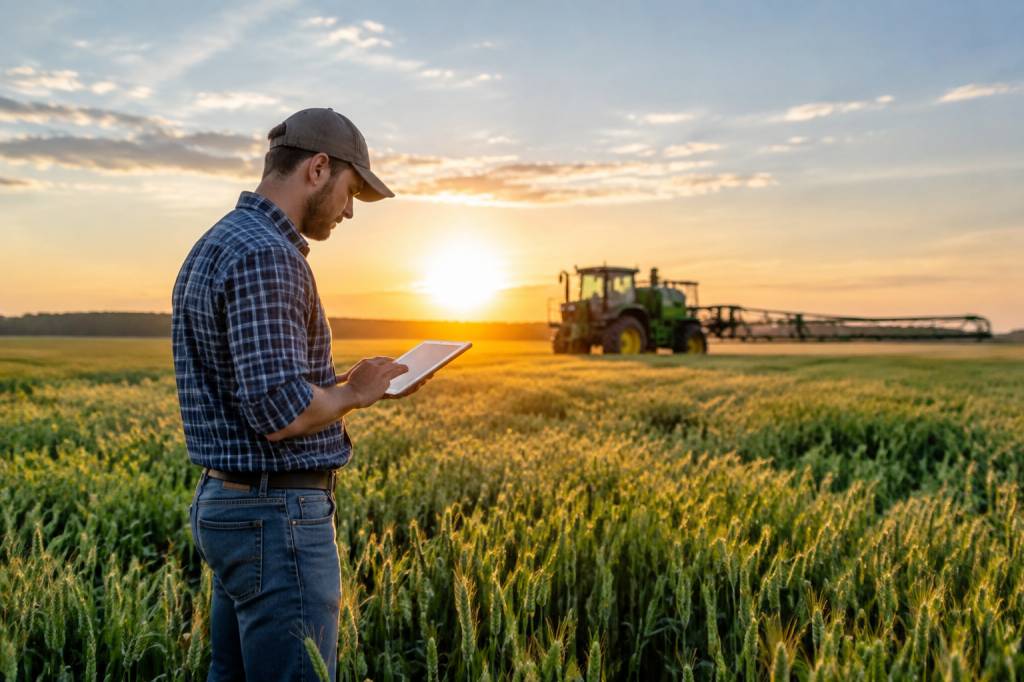
Agriculture is entering a new operational cycle. Farmers are facing higher input costs, water stress, labor shortages, soil degradation and increasingly unpredictable weather patterns. At the same time, global food demand continues to rise. Producing more with fewer resources is no longer a long-term ambition: it is becoming a daily management requirement.
Smart farming technologies are changing how this challenge is addressed. Sensors, satellite imagery, artificial intelligence, robotics and connected machinery are moving agriculture from broad estimates toward precise, data-based decisions. The objective is not to replace farmers with software. It is to give them better information, faster reactions and more control over their production systems.
From large grain farms to small horticultural operations, digital tools are gradually reshaping the way crops are planted, monitored, irrigated and harvested. The most relevant innovations are those that create measurable value in the field: lower water consumption, reduced chemical use, improved yields and greater resilience.
Why agriculture needs a smarter operating model
Traditional farming remains highly dependent on variables that are difficult to control. Rainfall can arrive too late or in excessive quantities. A pest outbreak can spread across a field in a matter of days. Soil fertility may vary significantly between two plots that appear identical from the road. Applying the same treatment everywhere is therefore increasingly inefficient.
Input prices have added pressure to farm margins. Fertilizers, fuel, seeds and plant protection products represent a significant share of operating costs. When these resources are applied uniformly, part of the investment may be wasted, while other areas of the field may receive too little.
Smart farming addresses this imbalance through what is often called precision agriculture. Instead of managing an entire farm as one homogeneous unit, the farmer can divide it into smaller management zones. Each zone is monitored and treated according to its actual condition.
This approach has a direct environmental benefit. Applying only the necessary amount of water, fertilizer or crop protection product helps reduce runoff, protects nearby waterways and preserves soil quality. It also improves economic performance, which is essential if sustainable practices are to be adopted at scale.
Connected sensors bring the field closer to the control room
One of the most accessible smart farming technologies is the agricultural sensor. Installed in the soil, on machinery or inside greenhouses, sensors collect information that was previously based on observation and experience alone.
Soil sensors can measure moisture, temperature, salinity and, in some cases, nutrient levels. This data helps determine when irrigation is actually required. A farmer no longer needs to water an entire plot simply because the surface looks dry. The decision can be based on readings taken at different depths and locations.
Weather stations provide another layer of operational intelligence. Local measurements of rainfall, wind speed, humidity and temperature are more useful than regional forecasts when planning spraying, irrigation or harvesting. For example, a treatment applied just before heavy rain may be ineffective and may increase the risk of chemical runoff.
In protected agriculture, connected sensors control elements such as ventilation, heating, lighting and humidity. A greenhouse can automatically adjust its environment according to crop requirements. This creates a more stable growing cycle and reduces the energy and water wasted by manual adjustments.
The value of sensors does not come from data collection alone. It comes from converting readings into practical decisions. A dashboard showing hundreds of indicators is not useful if the farmer cannot identify which action should be taken next.
Satellite imagery and drones reveal what the eye cannot see
Large fields can hide problems until visible symptoms appear. By that stage, the damage may already be significant. Satellite imagery and drones offer a way to detect variations earlier.
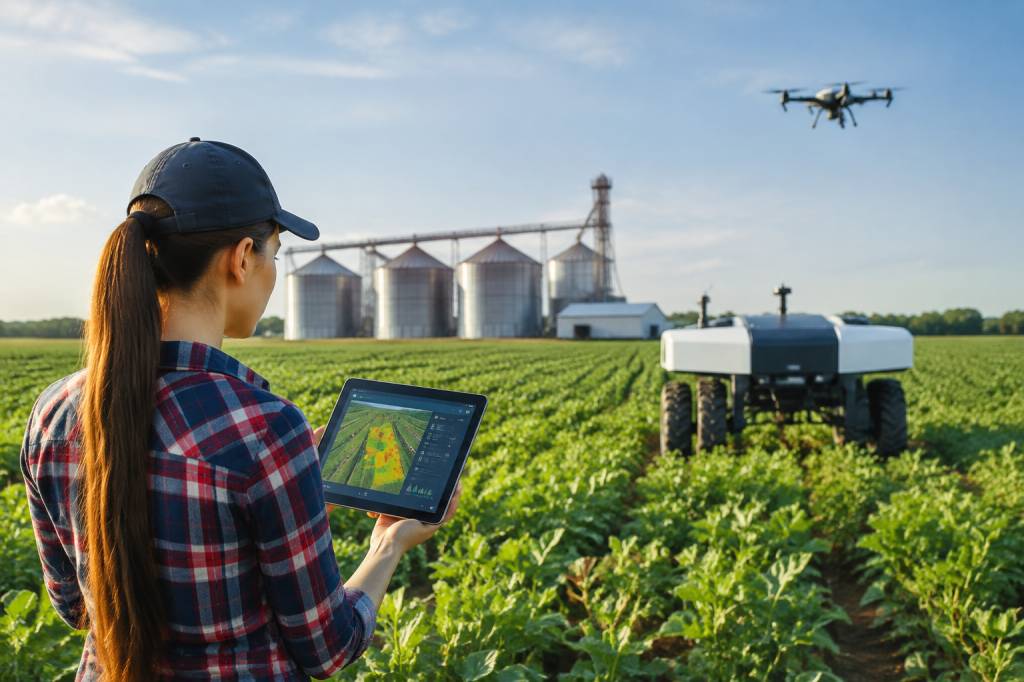
Multispectral cameras capture wavelengths that are not visible to the human eye. They can help identify plant stress, differences in vegetation density, water shortages or early signs of disease. A field may look uniformly green from the ground while imagery reveals specific areas requiring attention.
Satellite monitoring is particularly useful for tracking large areas over time. Farmers and agronomists can compare images from different dates to observe how crops are developing. This makes it easier to prioritize field inspections instead of sending teams to examine every hectare in the same way.
Drones provide more detailed and flexible observations. They can be deployed after severe weather, during a suspected pest outbreak or before harvest. Equipped with high-resolution cameras, some drones can map individual crop rows and identify gaps in planting or irregular growth.
There is, however, a practical limit. Images do not replace agronomic expertise. A digital map may show that a crop is under stress, but it does not always explain whether the cause is a lack of water, compacted soil, disease or poor drainage. Field verification remains essential.
Artificial intelligence turns farm data into recommendations
The volume of agricultural data is growing rapidly. Sensors, machinery, weather services and satellite platforms generate information at a speed that is difficult to process manually. Artificial intelligence can help identify patterns and support decisions.
Machine learning models can compare current conditions with historical data to estimate yield potential, predict disease risks or recommend irrigation schedules. Some systems analyze weather forecasts, soil measurements and crop development simultaneously. The result is a more dynamic form of farm management.
In crop protection, image recognition tools can identify weeds or disease symptoms from photographs taken by a smartphone, drone or machine-mounted camera. This allows farmers to target specific areas instead of treating an entire field. The potential reduction in chemical use is one of the strongest arguments for these systems.
AI can also support harvest planning. By estimating maturity levels across different zones, software can help determine where harvesting should begin and how machinery and labor should be allocated. In perishable products, better timing can reduce losses between the field and the buyer.
Still, agricultural AI must be treated as a decision-support tool rather than an infallible authority. A model trained in one region may perform less effectively in another because of different soils, varieties or climates. Data quality, local calibration and farmer feedback remain decisive.
Autonomous machinery is moving from demonstration to deployment
Modern agricultural machinery is becoming increasingly connected and automated. GPS-guided tractors can follow precise routes, reduce overlaps and operate with centimeter-level accuracy when supported by appropriate correction systems. This saves fuel, limits soil compaction and reduces the unnecessary use of inputs.
Variable-rate technology allows machinery to adjust the quantity of seed, fertilizer or crop protection product while moving across a field. Instead of applying a uniform dose, the equipment follows a digital prescription map based on soil analysis or crop conditions.
Autonomous tractors and robotic platforms are also gaining attention. These machines can perform repetitive tasks such as weeding, monitoring and targeted spraying. In fruit and vegetable production, smaller robots are being developed to navigate between rows and identify ripe produce.
The economic case depends on utilization. A highly automated machine may be difficult to justify for a small farm if it is used only a few days per year. Cooperative ownership, equipment-sharing networks and service providers could make these technologies more accessible. In many cases, farmers may not need to purchase the machine; they may simply buy the operation as a service.
Automation is particularly relevant where labor availability is uncertain. It does not eliminate the need for skilled workers, but it changes their role. Operators increasingly supervise systems, interpret data and manage exceptions rather than spending the entire day on repetitive manual tasks.
Smart irrigation: the most immediate sustainability opportunity
Water management is one of the clearest applications of smart farming. Agriculture accounts for a substantial share of global freshwater withdrawals, although the exact figure varies by region and methodology. In water-stressed areas, improving irrigation efficiency is no longer optional.
Connected irrigation systems combine soil moisture data, weather forecasts, crop growth stages and water availability. They can determine when irrigation should start, how long it should run and which zones require more or less water.
Drip irrigation delivers water directly near the roots, reducing evaporation and limiting wet areas where diseases can develop. When combined with sensors and automated valves, it becomes a precise distribution system rather than a fixed schedule.
Consider a vegetable farm divided into several blocks. One block may have sandy soil that drains quickly, while another retains moisture for longer. A single irrigation program will inevitably overwater one area or under-water the other. Smart control systems allow each block to be managed according to its physical characteristics.
The challenge is investment. Sensors, connectivity, pumps and control software involve upfront costs. Farmers also need technical support to configure the system correctly. Public incentives, water-management programs and cooperative models can help accelerate adoption, particularly among smaller producers.
Digital platforms improve traceability across the food chain
Smart agriculture does not stop at the farm gate. Digital platforms are connecting production data with storage, transport, processing and retail operations. This is especially important for food traceability and quality management.
A connected platform can record when a crop was planted, which products were applied, when it was harvested and under what conditions it was stored. This information can support certification, respond to food safety incidents and provide buyers with greater visibility.
For logistics operators, production forecasts can improve planning. If a platform indicates that a region will harvest a high volume of tomatoes within a narrow window, transport and cold-storage capacity can be prepared in advance. Better coordination reduces waiting time, spoilage and unnecessary journeys.
Blockchain is sometimes presented as a universal solution for traceability, but the technology is only useful if the information entered into the system is accurate. A secure record cannot correct false or incomplete data at the point of origin. Reliable processes and clear responsibilities remain more important than the label attached to the platform.
Regenerative practices and technology can work together
Sustainable food production is not limited to digital tools. Crop rotation, cover crops, reduced tillage, agroforestry and integrated pest management remain fundamental agricultural practices. Technology can make these approaches easier to monitor and manage.
Soil mapping can identify areas affected by erosion or compaction. Satellite data can track vegetation cover during periods when fields would traditionally remain bare. Carbon-monitoring tools are being developed to estimate changes in soil organic matter, although measurement standards are still evolving.
In precision livestock farming, wearable devices can monitor animal movement, feeding behavior and health indicators. Early detection of unusual behavior may allow farmers to intervene before a condition becomes more serious. This can improve animal welfare while reducing treatment costs.
The key issue is integration. A farm should not accumulate disconnected gadgets that each produce a separate application and login. The strongest results come from systems that communicate with one another and present information in a form that supports daily work.
The barriers: cost, connectivity and trust
Smart farming has clear potential, but adoption is not automatic. The first obstacle is cost. Hardware, subscriptions, maintenance and staff training can represent a significant investment, especially when farm revenues fluctuate.
Connectivity is another constraint. Rural areas may still lack reliable broadband or mobile coverage. Without a stable connection, real-time monitoring and remote control become difficult. Offline functionality and low-power networks are therefore important design priorities.
Data ownership also raises questions. Who controls information generated by a machine or sensor? Can it be shared with equipment manufacturers, insurers or buyers? Farmers need transparent contracts explaining how data is collected, stored and used.
Finally, technology must fit the realities of agricultural work. A solution that requires constant manual data entry will struggle to gain long-term adoption. Tools must be robust, easy to operate and compatible with existing machinery and workflows. The best interface may be the one the farmer barely notices because it simplifies rather than complicates the job.
What the next agricultural decade may look like
The future of farming will probably not be defined by one spectacular invention. It will be shaped by the combination of many practical technologies: low-cost sensors, better connectivity, autonomous equipment, predictive software and more accurate field data.
Farmers will increasingly manage production through digital maps and operational dashboards, while still relying on experience and physical observation. Machines will handle more repetitive tasks, but human decisions will remain essential when conditions change unexpectedly.
For food companies and logistics providers, the impact will extend beyond the farm. More accurate production forecasts will support procurement, storage and transport planning. Retailers may demand more detailed environmental and quality information from suppliers. Producers able to document efficient resource use could gain access to new markets and contractual advantages.
The central question is not whether agriculture will become digital. That process is already underway. The real question is whether digitalization will deliver measurable improvements for farmers, consumers and the environment.
Smart technologies will earn their place in sustainable food production when they help a farmer use less water, protect a field more precisely, reduce waste or make a better decision at the right moment. In agriculture, progress is rarely about pressing a button. It is about understanding the field more accurately—and acting before a small problem becomes a costly one.