Choosing a goat breed is not simply a matter of selecting the largest animal, the most attractive coat or the breed most often mentioned online. A productive herd must match the farm’s objectives, climate, available forage, labour capacity and market access. The right goat for a dairy operation may be a poor choice for meat production, while a hardy brush goat can outperform a high-yielding breed on difficult terrain.
For farmers, the decision is both biological and economic. Breed selection influences feed requirements, veterinary costs, kidding performance, product quality and resale value. Before purchasing animals, it is therefore useful to define what the farm needs to produce and what its land can realistically support.
Start with the farm’s production objective
Most goat farms focus on one of four activities: milk, meat, fibre or land management. Some combine several objectives, but a dual-purpose herd still needs a clear priority. Trying to maximise everything at once often results in average performance across the board.
- Dairy production: Choose breeds selected for milk volume, lactation persistence and udder quality.
- Meat production: Prioritise growth rate, carcass conformation, feed efficiency and kidding performance.
- Fibre production: Look for animals with consistent, high-quality cashmere or mohair.
- Brush and pasture management: Select hardy, mobile goats that can browse efficiently and tolerate variable conditions.
- Mixed farming: Consider dual-purpose breeds that deliver acceptable results in more than one market.
Market access should be part of the same conversation. A dairy breed has limited commercial value if there is no reliable outlet for fresh milk, cheese or yoghurt. Likewise, a meat breed may be difficult to justify where consumers prefer local dairy products. Production potential only becomes income when logistics, processing and sales channels are in place.
Dairy breeds: high output requires high management
Dairy goats are generally more demanding than hardy native or meat-oriented animals. High milk production requires a balanced ration, clean water, shelter, regular milking and close monitoring during late pregnancy and early lactation.
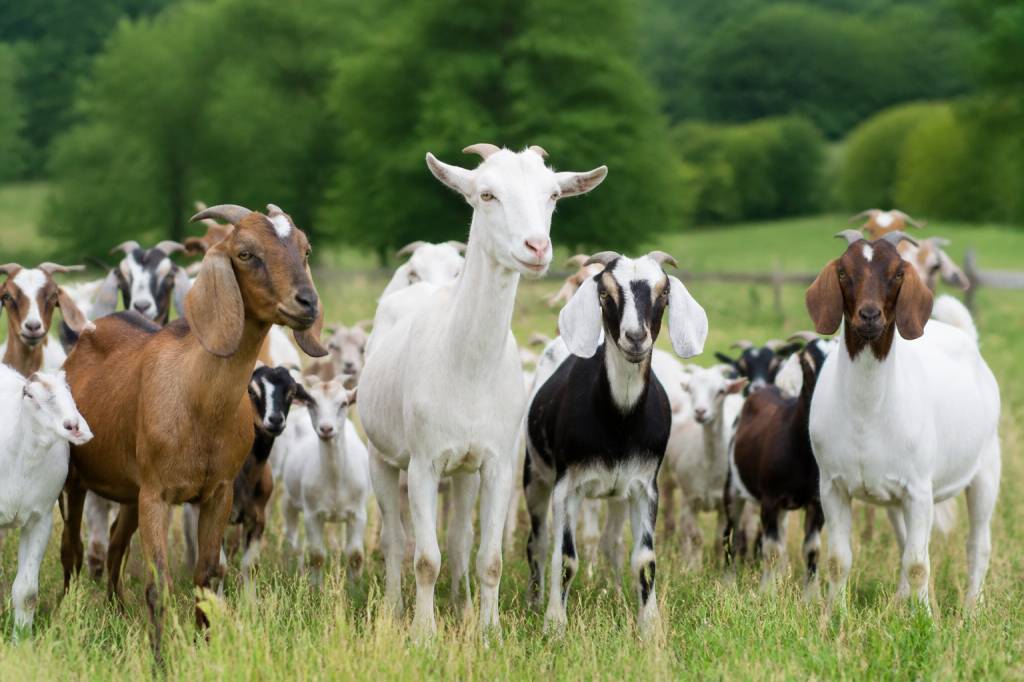
Saanen goats are among the best-known dairy breeds. Usually white or cream-coloured, they are recognised for substantial milk production and a calm temperament. They perform particularly well in organised dairy systems with good feed availability. However, their pale skin can make them more vulnerable to intense sunlight, and they may struggle if exposed to heat without shade and ventilation.
Alpine goats are valued for their adaptability and productive lactations. They come in several colour patterns and are often a strong choice for farms seeking a balance between milk yield and resilience. Alpines can perform in different climates, although management quality remains decisive.
LaMancha goats are easily identified by their very short external ears. They are known for good milk production, a steady temperament and relatively compact body structure. Their milk is often appreciated for cheese-making because of its useful composition, although results vary between individual animals and feeding systems.
Nubian goats, also called Anglo-Nubians in some markets, are recognised by their long, pendulous ears and convex facial profile. They tend to produce milk with a higher butterfat content, which is valuable for cheese, yoghurt and other processed products. Their milk volume may be lower than that of some specialised dairy breeds, but the richer composition can improve product margins.
Toggenburg goats are among the older established dairy breeds. They are generally robust, productive and well suited to cooler environments. Their performance can decline under excessive heat, so farmers in warm regions must pay particular attention to shade, water availability and airflow.
For a small dairy farm, the best animal is not always the one with the highest recorded yield. A goat producing slightly less milk but remaining healthy, fertile and easy to milk may generate better returns over several years. Longevity is an economic characteristic, not just a biological one.
Meat breeds: growth, fertility and feed efficiency
Meat production depends on more than final weight. The most profitable herd combines rapid kid growth, good survival rates, efficient conversion of forage and predictable kidding. A large goat that requires expensive feed may be less profitable than a medium-sized animal that raises twins successfully on pasture.
Boer goats are the leading specialist meat breed in many countries. They are recognised for muscular development, fast growth and strong carcass characteristics. Boer bucks are also frequently used in crossbreeding programmes to improve the meat performance of local does.
The main limitation is that Boer goats may not be the most efficient option in every environment. High-performing animals need appropriate nutrition, mineral supplementation and parasite control. On poor or highly seasonal pasture, a carefully selected crossbred animal can outperform a purebred Boer in overall farm profitability.
Kiko goats originated in New Zealand and were selected for hardiness, maternal ability and growth under relatively extensive conditions. They are often considered by farmers seeking lower-input meat production. Kikos can be useful where labour is limited and animals must rely heavily on grazing and browsing.
Spanish goats are valued for their toughness, browsing capacity and ability to cope with challenging landscapes. They may not match specialised breeds in growth rate, but they can offer strong performance where heat, rough terrain or limited forage are major constraints.
Savanna goats are another meat-oriented option, particularly in warm regions. Their white coat, hardiness and ability to perform in extensive systems make them attractive for commercial meat production. As with all breeds, local adaptation and breeder quality matter as much as the name on the registration certificate.
When evaluating meat goats, farmers should record birth weight, weaning weight, average daily gain, litter size and kid survival. Visual assessment is useful, but farm records usually reveal which animals are genuinely paying their way.
Fibre breeds: specialist value, specialist markets
Fibre goats occupy a narrower but potentially valuable market. Their success depends on fibre quality, processing capacity and access to buyers. A farm should not invest in fibre animals without understanding grading standards, shearing requirements and price volatility.
Angora goats produce mohair, a lustrous fibre used in clothing, upholstery and technical textiles. They are generally smaller and more delicate than meat breeds. Angoras require careful nutrition, particularly around kidding and shearing, because the loss of their insulating coat can expose them to cold stress.
Cashmere goats produce a fine undercoat harvested during the seasonal moult. Cashmere quality depends on fibre diameter, length, colour and the proportion of valuable down in the fleece. Production can vary considerably according to genetics, climate and management.
Fibre production may appear attractive because the product is lightweight and potentially high-value. Yet collection, sorting and marketing require expertise. A farm located far from a processor may face transport costs that erode the expected margin. In this sector, the supply chain is as important as the animal itself.
Hardy and dual-purpose breeds for smaller farms
Small and diversified farms often need flexibility rather than maximum performance in a single category. A dual-purpose breed can provide milk for household consumption, surplus kids for meat and useful browsing capacity.
Nigerian Dwarf goats are small dairy animals with relatively high milk solids for their size. They require less space and feed than larger dairy breeds, making them popular with smallholders and urban-edge farms. Their compact size also makes handling easier, although they are not designed to supply the same total milk volume as a full-sized dairy goat.
Oberhasli goats offer a combination of dairy potential, manageable size and a generally calm disposition. They can suit farms that want milk production without building a highly intensive system.
American Pygmy goats are mainly kept as companion or small utility animals. They can contribute to brush control and are easy to manage, but they should not be confused with commercial dairy or meat breeds.
Local and indigenous goats deserve serious consideration. They are often overlooked because they lack the marketing visibility of international breeds. However, they may possess valuable traits such as disease tolerance, heat resistance, browsing ability and efficient reproduction. In difficult environments, these characteristics can be more important than maximum production under ideal conditions.
Climate and terrain can change the decision
Goats are adaptable, but no breed is immune to its environment. Heat, humidity, altitude, winter temperatures and parasite pressure all influence performance.
- Hot climates: Prioritise shade tolerance, water access, heat resilience and light-coloured or locally adapted animals.
- Cold climates: Consider coat quality, shelter, kidding-season management and protection from wind and wet conditions.
- Humid regions: Pay close attention to hoof health, internal parasites and ventilation.
- Dry regions: Select animals that browse efficiently and maintain body condition with limited forage.
- Mountainous farms: Favour sure-footed, mobile goats with strong legs and sound hooves.
Parasite resistance is becoming increasingly important. Repeated use of dewormers has contributed to resistance in many goat-producing areas. Farmers should work with a veterinarian, use targeted treatments and select replacement animals that remain productive without constant medication.
Breed choice can also influence fencing requirements. Smaller goats may exploit gaps that larger animals ignore, while active breeds can challenge weak fences. A cheap fence that requires constant repair is not a cheap system.
Crossbreeding: a practical route to balanced performance
Crossbreeding can combine the strengths of different breeds. A Boer buck crossed with hardy local does may produce kids with improved growth while retaining some maternal adaptation. A dairy buck line crossed with a robust local population may improve milk production without sacrificing resilience.
The key is to define the purpose of the cross. Unplanned breeding creates a mixed herd with uncertain performance. A structured programme uses clear records and retains animals that meet specific targets, such as higher weaning weight, improved milk solids or better kidding rates.
Farmers should also avoid relying solely on breed labels. Within-breed variation is significant. A well-selected local goat can outperform a poorly managed registered animal. Before buying, inspect the herd, request health records and ask the breeder for performance data rather than general promises.
What to check before purchasing goats
The purchase decision should include a basic operational audit. The animal must be healthy today and suitable for the farm’s system over several production cycles.
- Check body condition without accepting excessive fat as proof of quality.
- Inspect the mouth, teeth, legs and hooves.
- Examine the udder for symmetry, good attachment and signs of previous injury in dairy does.
- Ask about vaccination, parasite control and disease testing.
- Review kidding records, litter size and kid survival where available.
- Observe the animal’s behaviour, movement and response to handling.
- Confirm that the breed is available locally for future replacement stock.
- Calculate transport, quarantine and adaptation costs before agreeing on a price.
Quarantine is essential when introducing new animals. Keep purchases separate long enough to observe illness, manage parasites and prevent the introduction of contagious diseases into the established herd. A single low-cost purchase can create a high-cost health problem if this step is ignored.
Build the decision around measurable farm economics
A useful comparison includes annual feed costs, labour, veterinary expenses, replacement rates, sale prices and expected productivity. For dairy goats, calculate income per lactation and not simply litres per day. For meat goats, measure saleable weight and kid survival. For fibre animals, include shearing, sorting and processing costs.
Farmers should also consider labour peaks. Dairy goats require daily milking, while meat herds may concentrate work around kidding and weaning. Fibre breeds create seasonal shearing obligations. The breed must fit the available workforce, not an imaginary schedule.
The best goat breed is ultimately the one that performs reliably within the farm’s real constraints. A high-output animal in a low-input system may become underfed, unhealthy and unprofitable. A hardy, moderately productive breed can deliver stronger results when it matches the land, the climate and the market.
For most farms, the soundest strategy is to begin with a manageable number of animals, collect detailed records for at least two production cycles and expand only after the system has proven itself. In goat farming, disciplined observation often beats fashionable genetics. The right breed is not the one with the longest list of advantages; it is the one that turns available resources into consistent, marketable output.