Wheat remains one of the world’s most strategic crops. It feeds billions of people, supports large commodity markets and provides a critical source of income for farms across Europe, North America, Asia and the Southern Hemisphere. Yet producing more wheat is no longer simply a matter of increasing acreage or applying more fertiliser. Input prices, water stress, soil degradation, extreme weather and stricter environmental standards are forcing farmers to rethink the entire production model.
The most competitive wheat farms are now combining agronomic discipline with data, targeted investment and better risk management. The objective is clear: raise yields where the soil and climate allow it, while protecting long-term fertility and controlling production costs. This balance is becoming a defining factor in the future of the sector.
Start with a precise understanding of the field
Yield improvement begins before the seed drill enters the field. A uniform fertilisation plan applied across an entire farm may be simple to manage, but it rarely reflects real soil conditions. Nutrient levels, pH, organic matter and water retention can vary significantly within the same parcel.
Soil mapping provides a more reliable starting point. Farmers can use laboratory sampling, electromagnetic sensors, satellite imagery or yield maps from previous harvests to identify productive and weaker zones. The information does not need to be excessively complex. Even a well-designed sampling grid can reveal where phosphorus, potassium, nitrogen or lime applications should be adjusted.
This approach brings two immediate benefits. First, it limits unnecessary input use in areas that already have sufficient nutrient reserves. Second, it directs investment toward parts of the field where an agronomic correction can generate a measurable return.
A practical soil management plan should examine:
- Soil pH and its effect on nutrient availability.
- Organic matter and biological activity.
- Compaction, drainage and water infiltration.
- Phosphorus and potassium reserves.
- Historic yield variations across the field.
- Risk of erosion and nutrient runoff.
For many farms, the first productivity gain is not a new machine or a new variety. It is better information about what is already happening underground.
Choose varieties for the production system, not only for maximum yield
Seed selection is one of the most important decisions in wheat production. However, the variety with the highest potential yield in a research trial is not automatically the most profitable option on a commercial farm. Performance depends on the local climate, sowing date, soil type, disease pressure, market requirements and the farm’s machinery capacity.
Farmers should assess varieties against several criteria:
- Yield stability across different seasons.
- Resistance to key diseases such as septoria, rusts and fusarium.
- Winter hardiness and tolerance to cold conditions.
- Resistance to lodging, particularly on fertile soils.
- Grain quality and suitability for milling, feed or industrial markets.
- Adaptation to early or delayed sowing windows.
A variety that produces slightly less in an ideal season but maintains performance during drought or disease pressure may deliver a stronger margin over time. In an increasingly volatile climate, stability has an economic value that should not be underestimated.
Diversifying varieties can also reduce operational risk. Planting several types with different maturity dates and resistance profiles spreads the harvest window and reduces exposure to a single disease or weather event. It is a simple form of portfolio management—only the assets happen to be fields rather than financial instruments.
Improve establishment through better seedbed management
Wheat has a demanding production schedule. Poor establishment can reduce yield potential before the crop has developed its first true leaves. Uneven emergence creates differences in plant development, weakens competition against weeds and complicates later management.
The right establishment strategy depends on soil moisture, residue levels, previous crops and available equipment. Conventional tillage may be appropriate in some heavy or poorly structured soils, while reduced tillage or direct drilling can help protect soil structure and reduce fuel consumption in other situations.
The key is not to follow a particular system for ideological reasons. The key is to create good seed-to-soil contact, preserve moisture and avoid excessive compaction. Seeds placed too deeply may emerge slowly. Seeds placed in dry soil may fail to establish evenly. A field that looks tidy after drilling is not necessarily a field that has been agronomically optimised.
Farmers should pay close attention to:
- Sowing depth and consistency across the working width.
- Seedbed moisture at drilling.
- Residue distribution from the previous crop.
- Wheel traffic and headland compaction.
- Plant population according to sowing date and variety.
Regular checks after drilling are essential. A quick field walk can reveal gaps, crusting, slug activity or poor seed placement while corrective action is still possible.
Use nitrogen more efficiently
Nitrogen is often the largest variable input in wheat production and one of the most difficult to manage. Too little nitrogen limits yield and protein. Too much increases costs, lodging risk and emissions, while creating a greater chance of nitrate losses.
The most effective programmes match nitrogen supply with crop demand. This requires more than applying a standard rate based on farm habit. Previous crop, soil mineral nitrogen, expected yield, rainfall, variety and grain quality targets all influence the final requirement.
Splitting applications can improve efficiency. An early dose supports tillering and canopy development, while later applications can be adjusted according to crop condition, yield potential and protein objectives. In regions exposed to spring drought, timing becomes especially important because fertiliser needs sufficient soil moisture to be taken up by the plant.
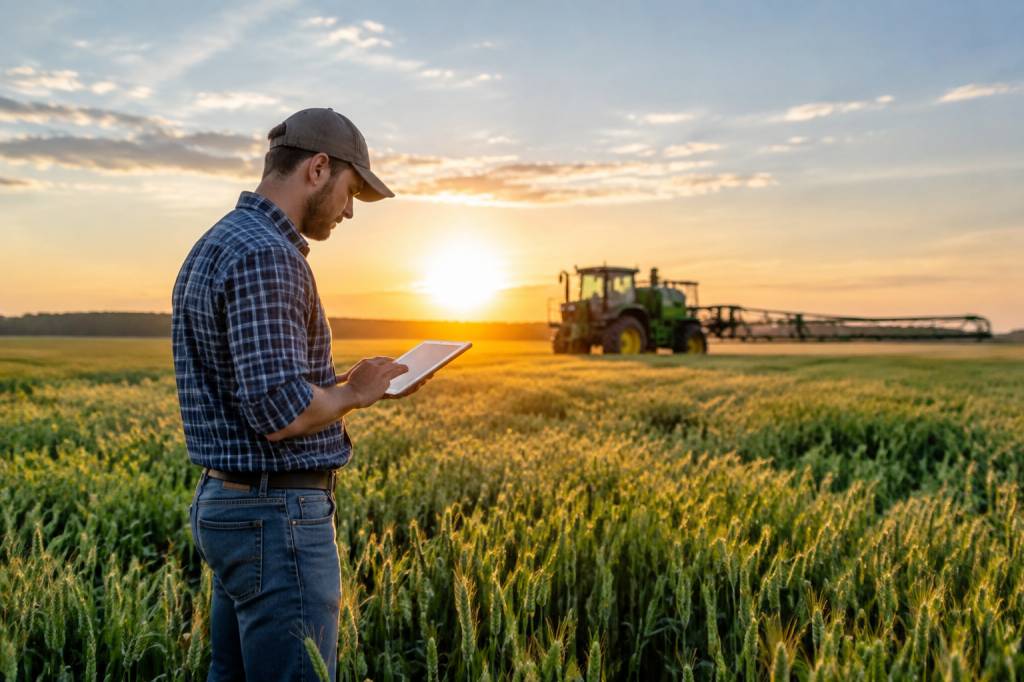
Technology can support these decisions. Crop sensors, satellite imagery, drone observations and variable-rate spreaders allow farmers to identify differences in biomass and adjust applications accordingly. These systems are not magic solutions, but they can make a good agronomic plan more precise.
Efficient nitrogen management also depends on basic operational discipline:
- Calibrate spreaders before the season and after maintenance work.
- Avoid application before heavy rainfall where runoff is likely.
- Keep accurate records of rates, dates and field conditions.
- Compare applications with yield, protein and margin results.
- Use local forecasts to improve timing.
The question is not simply how much nitrogen the crop receives. It is how much of that nitrogen becomes saleable grain.
Protect the crop with integrated disease and pest management
Crop protection remains essential for yield security, but routine spraying without field observation is becoming increasingly difficult to justify economically and environmentally. Resistance to fungicides and insecticides is a growing concern, while regulatory pressure is encouraging more targeted use of plant protection products.
Integrated management begins with prevention. Resistant varieties, balanced rotations, clean seed, residue management and appropriate sowing dates can reduce disease pressure before chemical intervention is considered. Monitoring then determines whether treatment is required and when it is most likely to deliver a return.
Scouting should not be limited to the field edge. Disease development can vary considerably across a parcel, particularly where humidity, canopy density or soil conditions differ. Farmers and agronomists should inspect lower leaves, stems and developing ears, recording both the presence and the progression of symptoms.
Fungicide programmes should be based on risk rather than habit. Weather conditions, variety resistance, growth stage and disease observations all matter. Applying a product too early may leave the crop unprotected later. Applying too late may protect the paperwork more than the yield.
Weed control also deserves strategic attention. Competitive wheat stands can suppress many weeds, but blackgrass, ryegrass and other herbicide-resistant species require long-term rotation and cultural measures. Delayed sowing, mechanical control, competitive varieties and cover crops may all form part of the solution.
Build soil resilience for difficult seasons
Higher yields are valuable, but yield stability may be even more important. A farm that produces 9 tonnes per hectare in a favourable year and 5 tonnes during a dry season faces a very different financial reality from one that consistently produces between 7 and 8 tonnes.
Soil health is central to this resilience. Organic matter improves structure, water retention and biological activity. Good drainage reduces waterlogging, while adequate infiltration helps rainfall reach the root zone instead of running off the field.
Crop rotation is one of the most effective tools available. Wheat grown after a break crop such as oilseed rape, beans, peas or another suitable crop may benefit from better disease management and improved soil conditions. Rotations can also spread workloads and reduce dependence on a narrow range of herbicides.
Cover crops can protect soil between cash crops, although they must be selected carefully. A cover crop that consumes valuable soil moisture before wheat establishment may create a problem instead of solving one. Local climate, termination method and water availability should guide the decision.
Reducing unnecessary passes across the field can lower fuel use and compaction. Controlled traffic systems, wider working widths and better route planning are increasingly relevant as diesel prices and machinery costs remain under pressure.
Make data useful at farm level
Precision agriculture is often presented through sophisticated dashboards, autonomous machinery and artificial intelligence. These technologies are advancing quickly, but their value depends on whether they improve a real farm decision.
A yield map is useful when it leads to a change in seed rate, drainage investment or nutrient management. A satellite image is useful when it helps identify a crop problem early enough to act. A machinery telematics system is useful when it reduces downtime, fuel consumption or operator error.
Farmers should avoid collecting data simply because the software makes it possible. Start with a clear question:
- Why is one part of the field consistently underperforming?
- Can nitrogen rates be reduced without lowering margin?
- Where is compaction limiting root development?
- Which variety performs best on specific soil types?
- How much time and fuel are being lost during field operations?
Once the question is defined, the appropriate tool becomes easier to identify. In some cases, a mobile phone, a notebook and regular field walks will provide more value than an expensive platform that nobody uses properly.
Control costs through margin-based decisions
Yield alone does not determine business performance. A high-yielding crop can deliver a weak margin if it requires excessive fertiliser, multiple fungicide passes, high drying costs or expensive machinery operations.
Each major intervention should be assessed against its expected return. This does not mean cutting inputs indiscriminately. It means distinguishing between expenditure that protects yield, expenditure that increases yield and expenditure that has become routine without a clear benefit.
Useful indicators include:
- Gross margin per hectare.
- Cost per tonne produced.
- Nitrogen use efficiency.
- Fuel consumption per field operation.
- Machinery cost per hectare.
- Yield variability between fields and seasons.
Storage and marketing also influence the final result. On-farm storage may offer flexibility when harvest prices are weak, but it brings capital, energy, maintenance and quality risks. Contracts can provide certainty, while spot-market sales may offer opportunities when prices rise. A balanced marketing plan is generally more robust than relying on a single strategy.
Prepare for climate and market volatility
Wheat farmers are operating in an environment shaped by uncertain weather, geopolitical tensions, changing trade flows and volatile input prices. No agronomic plan can remove these risks, but a diversified and disciplined business can reduce its exposure.
Water management will become increasingly important in many production regions. Efficient irrigation, soil moisture monitoring, drought-tolerant varieties and adjusted sowing dates can help protect yield potential. In rainfed systems, the focus should be on preserving soil moisture and building root systems capable of accessing water deeper in the profile.
Farmers should also maintain relationships with agronomists, cooperatives, buyers, machinery suppliers and neighbouring producers. Practical knowledge often travels faster through a local network than through a technical report. An observation made in one field can prevent a costly mistake in another.
The strongest wheat strategies are not based on one spectacular innovation. They combine accurate field knowledge, appropriate genetics, careful establishment, efficient nutrition, targeted crop protection and rigorous cost control. Sustainability is not an additional layer added after productivity has been achieved. It is increasingly the condition that makes productivity possible over the long term.
For wheat businesses, the most useful question is therefore not simply, “How can we produce more this year?” It is, “How can we produce a reliable tonne of quality grain, with fewer wasted inputs, while keeping the soil productive for the next crop?” That shift in perspective is already changing the way modern farms measure performance—and it will shape the competitiveness of the sector for years to come.